

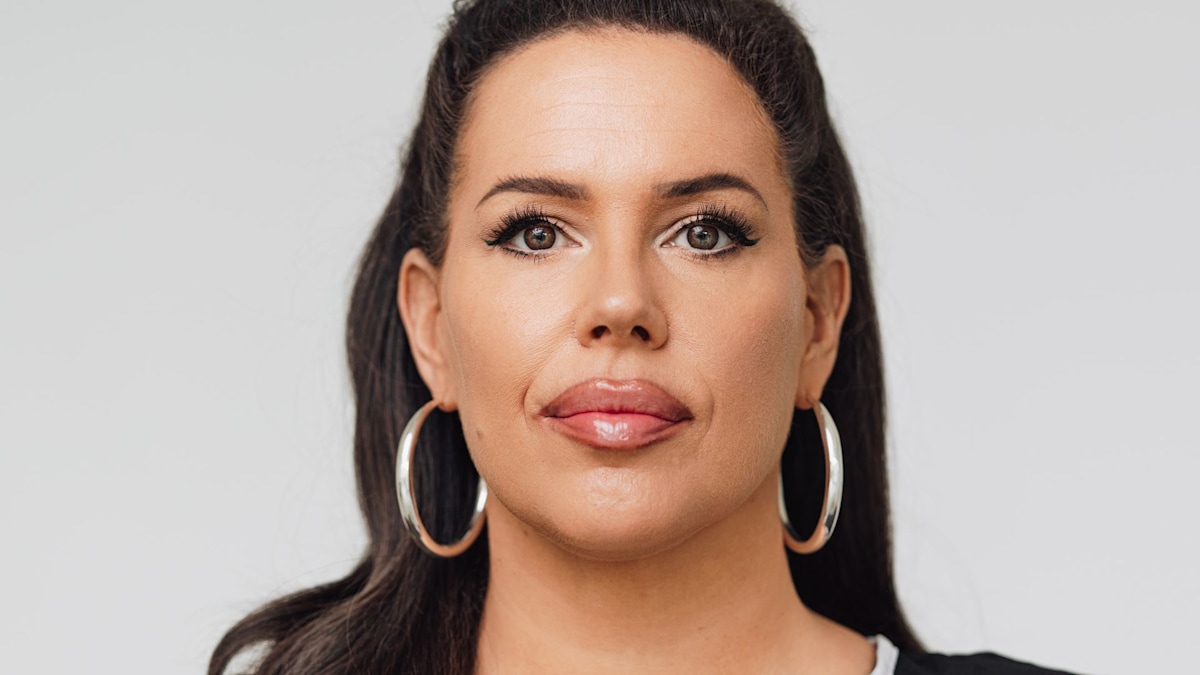

“Being a teenager in the 90s, the era of hip bones protruding above low-slung jeans and so-called ‘heroin chic’ was excruciating,” Natasha Devon MBE reveals as she reflects on her journey with severe bulimia nervosa. Now, at 44-years-old and a campaigner for mental health awareness, body positivity, and social equality, she looks back on her early years and understands her former self in a way she couldn’t for a very long time.
Natasha opens up about her struggles with disordered eating to HELLO! as the UK’s eating disorder charity Beat begins its annual drive to raise awareness with Eating Disorders Awareness Week, from 23 February until 2 March. But while the influx of conversation around the various mental health conditions lasts seven days, for victims like Natasha, remnants of her bulimia will linger for the rest of her life.
The writer and LBC broadcaster started experiencing negative thoughts towards her body when she was in primary school. Showing up with a taller, stronger body shape, she struggled with feeling feminine in a time that didn’t champion her natural physique. “I went on my first diet when I was ten. I hated how I looked and sort of disassociated from my body in a very unhealthy way. I also had, I now recognise, an undiagnosed anxiety disorder during this time and was having panic attacks.”
She continues: “I think I was probably engaging in disordered eating before this point, but it was so normalised in society that I didn’t properly realise I had a problem until I started binging and purging during my first year of university.
“Even then, there were so many casual references to glamorous, functioning women being ‘bulimic’ in pop culture (the one I remember in particular was Cruel Intentions) that I was able to shrug it off as ‘no big deal’.”
An unanswered call for help
After years of silently battling with her own head, Natasha finally decided it was time to ask for help in her third year of university. She visited her GP’s office and was met with a devastating, disappointing blow when she was turned away for not meeting stereotypical criteria.
“The GP weighed me, told me that I ‘wasn’t underweight’, and therefore he couldn’t refer me to eating disorder services. I can’t tell you how shaming the experience was, which is why I now support Hope Virgo’s ‘Dump the Scales’ campaign – eating disorders are a mental illness and are measured in distress, not pounds,” she explains.
The radio show host adds: “I did book a couple of sessions to see the counsellor on campus at this time, and I remember that she was helpful, but the sense that I didn’t ‘really’ have an eating disorder (because I wasn’t thin enough) and I was therefore ‘wasting her time’ ultimately stopped me from going.”
“Eating disorders can happen to anyone, and sometimes it’s the people you least suspect.”
Dealing with a new diagnosis
As she fell deeper into her disorder throughout her mid-twenties, Natasha was struggling to stay afloat. Between her disordered eating behaviours and worsening panic attacks, her life was no longer her own.
“I couldn’t hold down a job and had alienated most of my friends. I went to my GP again, was referred to mental health services, received a diagnosis of ‘severe bulimia nervosa’ and was prescribed CBT (Cognitive Behavioural Therapy),” she says.
Receiving her bulimia diagnosis helped alleviate some of the pressure on her mind and body, as she learned to deal with her behaviour by implementing CBT techniques that reduced the number of purges and binges she was experiencing – but it was only addressing half the problem.
Natasha explains: “It didn’t address the underlying anxiety. It was much later (in my early 30s) that I got a diagnosis of panic disorder, and it was as though some jigsaw pieces fell into place.
“Once I began to address anxiety, through a combination of medication, therapy and lifestyle changes, my relationship with my body, food and exercise also began to properly heal.”
Hiding in plain sight… or so she thought
One of the most difficult things about an eating disorder is the emotional toll it takes on relationships with family and friends, something Natasha experienced firsthand. She believed she was concealing her struggles from her loved ones, only to find out the opposite was true.
“I had used all kinds of creative ways to try and hide the behavioural elements of bulimia from the people around me, so when I did start telling friends and family, I was surprised by how many of them already knew.
“One friend said, ‘People can always tell if you have been sick in their house,’ which filled me with horror. Several told me they had really wanted to talk to me about it, but didn’t know how to broach the conversation.”
Ultimately, during such sensitive times, it is hard to know how to approach a topic without offending or upsetting the person in need of help. Natasha reveals: “What I needed was for my friends not to judge me, to listen to how I was feeling and ask what they could do to support my recovery.”
She highlights: “I am lucky enough to have someone who did that. I also realised that I had inadvertently attracted quite a lot of other people into my life who also had eating disorders, and that we were enabling each other, so I had to distance myself.
“The kindest thing a friend did for me was try to minimise the amount of diet and body chat that was happening in my orbit. When other people we knew started moaning about their own bodies, or other people’s, she’d say, ‘This is really boring, let’s change the subject’.”
Three-stage ‘active’ recovery
For the campaigner who has been visiting schools to deliver talks on mental health and body image since 2008, recovery was three-pronged. Managing symptoms like binge triggers, working through trauma and understanding how to be physically healthy again consumed Natasha’s life until she could confidently say she was in “active recovery” from her bulimia and anxiety.
“Whilst I would describe myself as recovered from bulimia, I’m still in active recovery with anxiety: I took a type of SSRI called Sertraline for several years and, although I do not take it anymore, I still have regular somatic therapy (which focuses on the mind/body connection) and have to be quite strict with keeping to a lifestyle structure that helps me to manage my mental health,” she outlines.
Natasha paints the picture of her recovery journey that was peppered with relapses as she figured out what worked best for her mind and body. “This took place over the course of several years, and it wasn’t linear. I relapsed several times. You can’t rush recovery, sadly, but it’s so worth it.
“Through phases one and two, I gained quite a lot of weight and was larger than is normal for my body. I made peace with that because I was prioritising my mental health, but I wasn’t physically as healthy as I’d have liked. Only when I had let go of my toxic attitude to food and exercise could I start to re-learn a physically healthy lifestyle and not get obsessed with it.”
“People like you best when you’re being yourself.”
‘Authenticity’ and awareness are key
From her position now, Natasha glances over her shoulder at how far she has come and reveals why, to her and so many others, awareness and information are life-changing.
She says: “I haven’t relapsed with bulimia now for more than a decade, and I can honestly say I don’t think about it that much. That chapter in my life has closed. I hope that by sharing more about my recovery, I can give people the genuinely useful information they need and help them realise there is hope.
“I am so glad in terms of how far we’ve come on raising awareness of eating disorders. When I was a young woman, eating disorder stories were all ‘before and after’ pictures and usually featured images of women in their underwear with hugely triggering details about weights, calories, specific food regimes and how they hid it from the people around them.”
Finally, she shares the message she would send to her younger self while she was in the depths of her disorder, struggling to gain control over her mental health. “People like you best when you’re being yourself.
“I was trying so hard to be someone else, someone I believed was cooler and more attractive, because I thought that was what success looks like. I couldn’t have been more wrong. Authenticity is how we find belonging and purpose, which are key to wellbeing and happiness.”
She would directly tell that little girl, “You’re not meant to be thin. Some people are naturally predisposed to slenderness, and that’s fine, but you’re not one of them. There are lots of brilliant things about your body type, though, so lean into it!”
If you, or someone you know, is struggling with an eating disorder, there are plenty of resources available from charities like Beat that can offer help.
Read the full article here