



Guillermo del Toro has done it again. The Mexican filmmaker’s haunting new version of “Frankenstein” emerged as one of the big winners at the 2026 British Academy Film Awards, securing multiple honors in key technical categories and reaffirming his status as one of global cinema’s most distinctive auteurs.
At the 2026 ceremony hosted by the British Academy of Film and Television Arts, “Frankenstein” triumphed in Production Design, Costume Design, and Makeup and Hair. These are not secondary achievements. They are the architectural bones of Del Toro’s cinematic universe. When he builds a world, he builds it completely. And by hand.
A Gothic Vision That Redefines Horror
“Frankenstein” is a 2025 American Gothic science fiction horror film written, produced, and directed by Guillermo del Toro. Based on “Frankenstein” by Mary Shelley, the film reimagines the literary classic with operatic melancholy and emotional intensity.
Oscar Isaac plays Victor Frankenstein, a brilliant but arrogant scientist whose obsession with transcending death leads to catastrophic consequences. Jacob Elordi takes on the role of the Creature, bringing a fragile physicality and aching vulnerability to the screen. Mia Goth and Christoph Waltz round out a cast that moves comfortably within Del Toro’s shadow-drenched aesthetic.
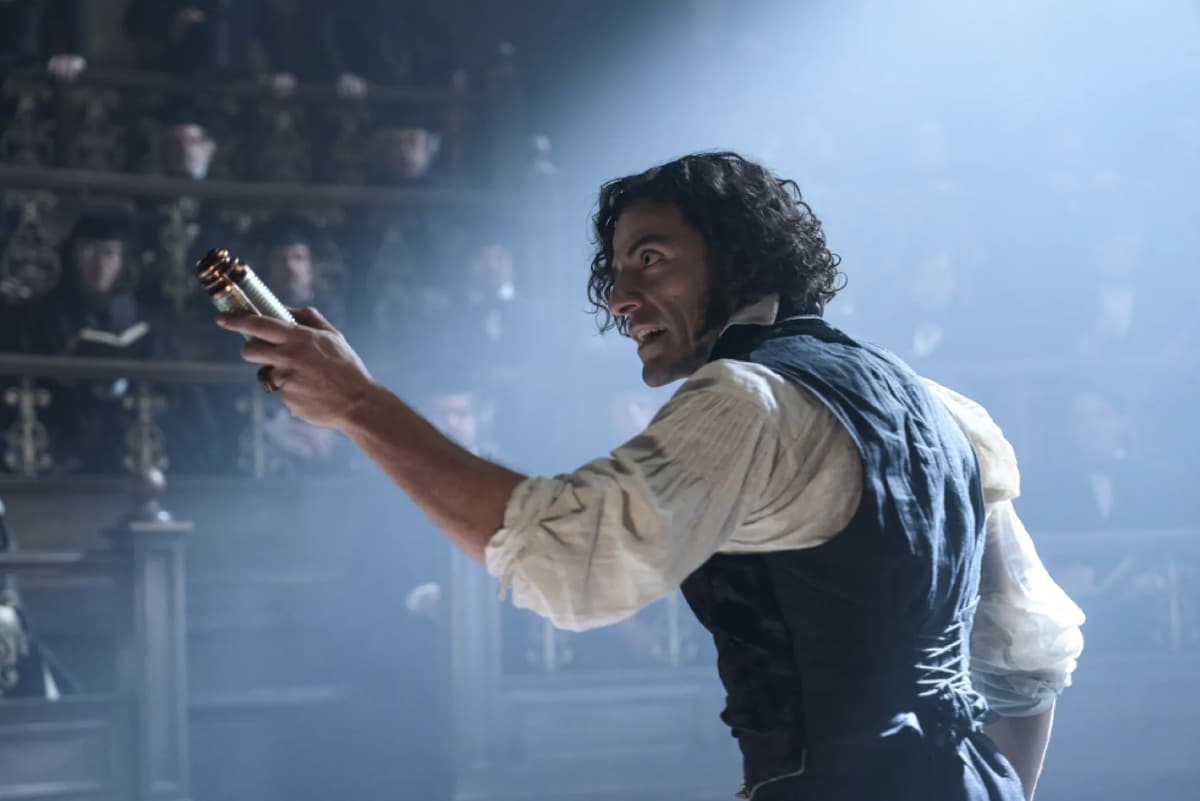 © Ken Woroner/Netflix
This adaptation does not treat the monster as a spectacle. It treats him as a wound. For Del Toro, monsters are mirrors. They reflect human fragility, loneliness, and moral failure. That philosophical throughline has defined his career, from fairy-tale horrors to wartime fantasies. Here, it reaches full maturity.
Craft as Storytelling Power
The BAFTA recognition underscores what critics have emphasized since the film’s premiere: this is meticulous, handcrafted cinema. The production design evokes decaying laboratories, candlelit corridors, and snow-covered graveyards with painterly precision. The costumes layer texture and historical authenticity without sacrificing theatrical flair. The makeup and hair department transforms Elordi into a tragic figure who feels stitched from both flesh and sorrow.
 © Getty Images for BAFTA
Del Toro, who refuses to use AI in his films, has long championed practical effects and tactile artistry. The Creature’s physical presence feels tangible, not digital. That materiality amplifies the emotional weight. You believe in the stitches. You believe in the scars.
 © Getty Images for AFI
In 2025, while headlines scream about AI’s potential to take over the world, del Toro said that “the danger isn’t artificial intelligence,” but “it’s natural stupidity.” It’s a sharp jab at the hubris of humans who build tools they don’t fully understand and deploy them without restraint. It is a sharp jab at the lack of restraint and the arrogance of humans who deploy tools they don’t fully comprehend.
His film premiered at the Venice International Film Festival on August 30, 2025, where it immediately became one of the most discussed titles of the festival season. It later received a limited theatrical release in the United States before launching globally on Netflix in November 2025.
From Dream Project to Awards Contender
This adaptation was not an overnight success. Del Toro has described “Frankenstein” as a lifelong dream project. Years ago, the film was in development at Universal Pictures, where it was briefly connected to the studio’s planned Dark Universe franchise. When that initiative stalled, the project was shelved.
 © Getty Images for BFI
It was Netflix that revived the vision in 2023, giving Del Toro full creative freedom. Filming took place between February and September 2024, allowing the director time to shape every visual and emotional detail.
A crucial aesthetic influence was the illustrated work of Bernie Wrightson, whose “Frankenstein” art deeply informed the film’s look. Although Wrightson passed away in 2017, his gothic illustrations remain embedded in the film’s DNA, visible in the Creature’s design and the shadow-heavy compositions.
Awards, Momentum, and Industry Prestige
BAFTA recognition adds to an already impressive awards trajectory. The film earned five nominations at the Golden Globe Awards, including Best Motion Picture – Drama. It also secured nine nominations at the Academy Awards, including Best Picture, Best Adapted Screenplay, and Best Supporting Actor for Elordi.
Both the National Board of Review and the American Film Institute named it among the top ten films of 2025, cementing its position within the year’s most significant cinematic achievements.
 © Netflix
For Del Toro, this moment strengthens a career defined by creative risk. He proves, once again, that genre cinema can stand shoulder to shoulder with prestige drama without surrendering its identity. Gothic horror, in his hands, becomes high art without losing its emotional pulse.
The 2026 BAFTA wins confirm that audiences and institutions alike are ready to embrace ambitious, visually daring storytelling.
Read the full article here