

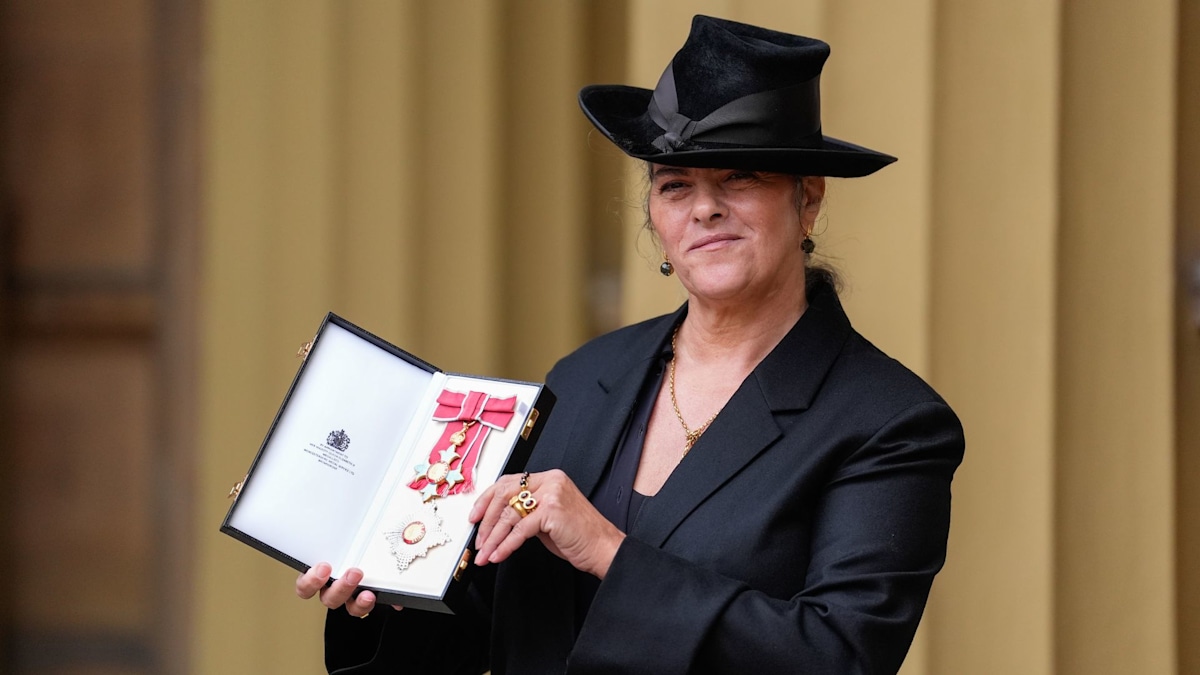

She was once known as the “bad girl of British art”, and now Dame Tracey Emin’s career is being celebrated at the Tate Modern in a major retrospective of her work, which spans four decades.
“She is probably our most significant – and certainly most powerful – British artist of her generation,” says Maria Balshaw, Tate director and curator of the exhibition. “She’s a household name.”
Not least because of her unapologetic, uncompromising and confessional approach to her art. This has scandalised, moved and delighted public and critics in equal measure, as well as earning her celebrity fans including Harry Styles, Sir Elton John and Madonna, who recently paid the artist a visit in her hometown of Margate.
And before the exhibition opened on 27 February, more famous faces gathered in the Turbine Hall of the Tate Modern to celebrate her impact, among them actress Anna Friel and her daughter Gracie. Anna told HELLO! that she had been a fan of Tracey “for a long time. I was just filming in Margate, and she’s got the most amazing studio.”
Other guests included singer Nick Cave, who HELLO! saw being ushered into the exhibition, and Bianca Jagger, who wore a white suit with strands of pearls around her neck.
The exhibition
Tracey Emin: A Second Life brings together more than 90 works encompassing her painting, sculpture, installation, textile, video and neon art from when she first burst onto the art scene in the early 1990s – as one of the famous set of Young British Artists – to the present day. Among them is her seminal 1998 work My Bed, which was last exhibited in London in 2011, and is anticipated to draw the biggest crowds. The controversial installation with soiled sheets and various detritus caused outrage when it was first shown in 1999.
“It changed art, and said the ordinary things of a woman’s life – messy sheets, tampons, all the things that every woman has experienced – can be art in the hands of an incredible artist. It seems rather quaint to me that male critics got upset [at the time],” says Maria.
She now counts the artists as a friend but admits she was “starstruck” and “terrified” when she first met Tracey in 2007 at her home in Spitalfields, east London, when Maria was then the director of the Whitworth Art Gallery in Manchester.
This is the first exhibition Maria has curated since becoming director of the Tate (which covers Tate Britain and Modern as well as Liverpool and St Ives), nine years ago, and is the swansong of her career there before she leaves at the end of March. “I decided that was my high point – a good point [to end],” she has said of the exhibition.
 © Photo © Tate (Sonal Bakrania)
The title of the show is also significant. Five years ago, Tracey was diagnosed with squamous cell bladder cancer, requiring dramatic surgery to remove her bladder, womb, lymph nodes and urethra, and given a stoma [a hole in her abdomen] for a urostomy bag. So far she has defied the odds – only about 33% of people survive five years after diagnosis – and has continued to produce new work. “She feels she’s been given a second chance,” says Maria.
Planning began in 2022 because museums and private collectors from around the world were approached to lend the work. No one refused – but the Tate never divulges the identity of private owners, including celebrity ones. Maria “very much hopes” that Madonna will visit the exhibition, but she’s not the only celebrity who is deeply appreciative of Tracey’s work.
Famous fans
“You’ll find Harry Styles is a big fan. He came to see Tracey’s show in Florence and is a committed collector of her work,” she says.
“Another great celebrity collector and long-term friend is Elton John. Musicians love her, including Annie Lennox and Paloma Faith. Out-there, feminist women tend to rally around Tracey.”
The exhibition charts the key life events that have shaped Tracey’s journey, including rape and sexual assault, and Maria concedes that it is an emotional roller coaster. “As you move through the rooms you get a strong sense of the challenges she’s faced, her sexuality and relationships. Love and death and pain and joy are Tracey’s subjects.”
Tracey in private
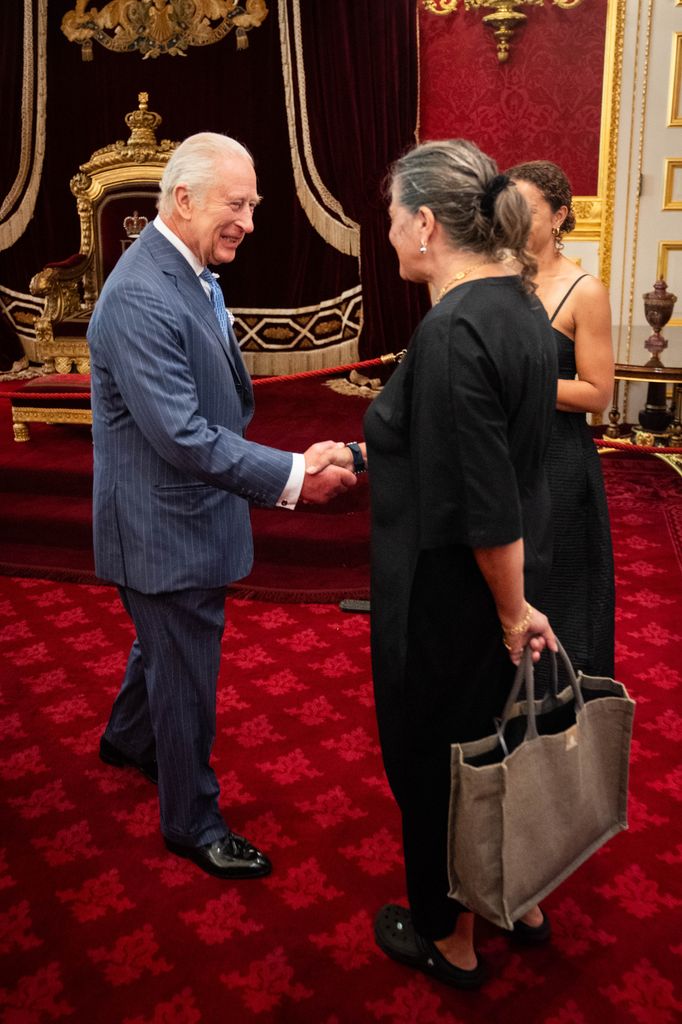
There’s little to separate the public and private persona of the artist. “She is as her work is – direct, down-to-earth, emotionally honest, opinionated. But the private Tracey is very funny, tender and sentimental.
 © PA Images via Getty Images
“Her beloved cats [Pancake and Teacup] feature in the exhibition and are an important part of her life. She is an immensely loyal friend and champion of other people, and in recent years has become a huge advocate for younger artists.” Through her philanthropic foundation Tracey has created an art school, studios and low-rent housing for artists in Margate, where she grew up and is now based.
Tracey has been accused of self-indulgence and lack of boundaries over the years, described by one critic as having “boasted about her promiscuity and called it art”.
How does Maria consider the criticism? “We just have to name and recognise that kind of deep misogyny,” she says. “Tracey was mocked and humiliated. Thank God we live in a different world 1772193698. The young curators I work with now look at the media coverage [of the time] and say, ‘How did she bear it?’ To them it is unacceptable.”
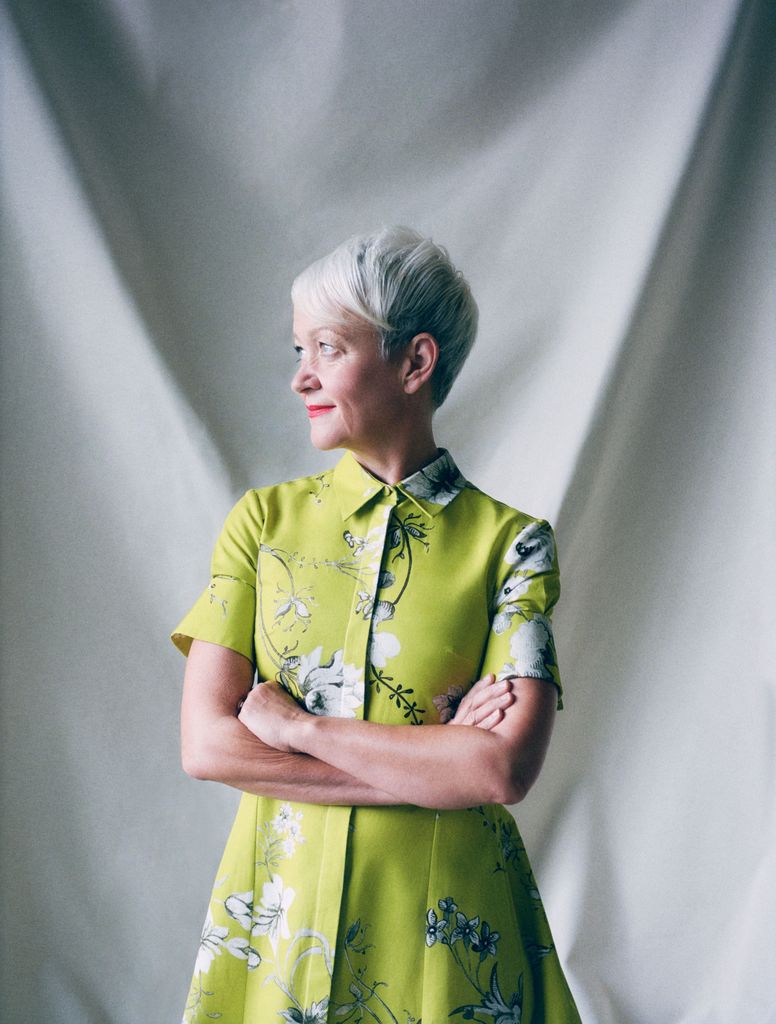
As her tenure comes to an end, Maria is looking forward to a more low-key career working on independent creative projects and focusing on her garden. “On 1 April I will be standing in my vegetable garden in my wellies,” she smiles.
How would she like the public to feel after seeing the exhibition? “Tracey once said, ‘The worst thing I can imagine is to feel numb, not to feel at all.’ So her wish from the beginning has been, ‘I don’t want people to think first, I want them to feel first when they encounter the work.’”
Tracey Emin: A Second Life is open from 27 February to 31 August. For more information visit Tate.org.uk
Read the full article here