

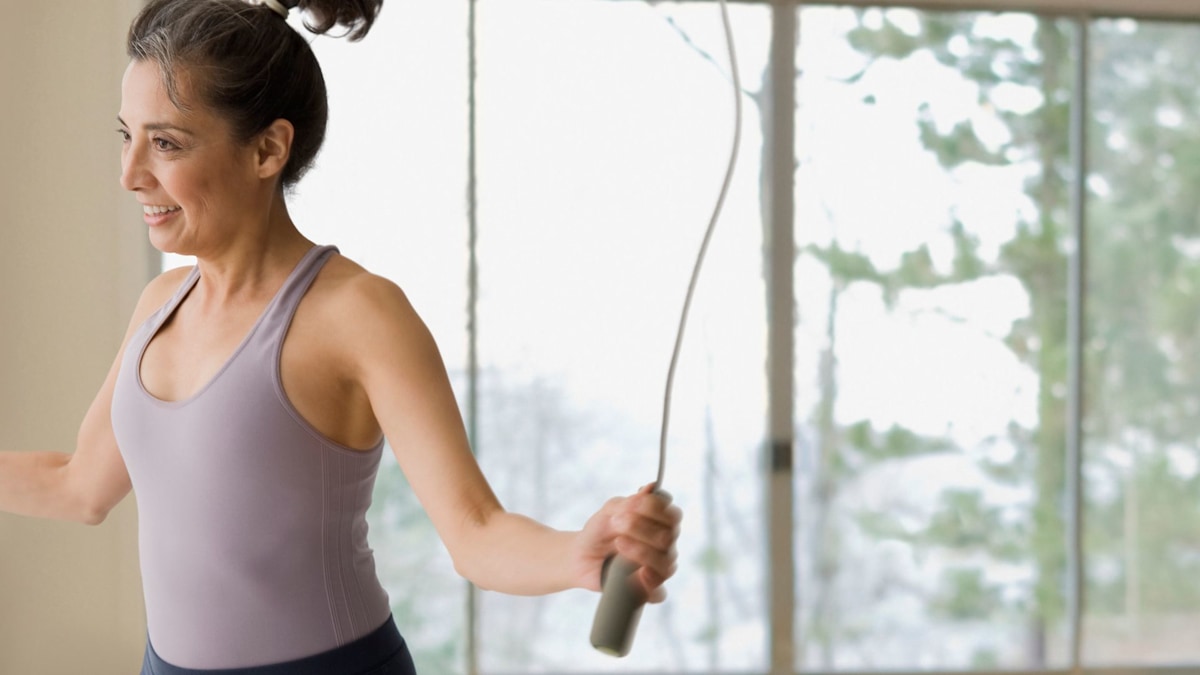

A recent TikTok trend suggested that doing 50 jumps every morning is a power fitness hack to boost circulation and promote lymphatic drainage. Plyometrics is high-intensity training that includes explosive movements such as jumping, hopping and skipping, but is it suitable for midlife women?
Plyometric training: What’s good about it?
Plyometrics isn’t just for world-class athletes; it can benefit midlife women in various ways. When done safely and regularly, jump training can support longevity by improving balance and joint stability, encouraging stronger bones, and reducing the risk of falls as we age.
Roisin O’Bentley, Founder of Thrive Physiotherapy for Women, says that plyometric training can be beneficial and safe for midlife women. “High-impact exercises are supported by research for maintaining bone density, muscle strength, balance and power, all of which are especially important as oestrogen levels change during perimenopause and menopause,” she confirms.
Research found that plyometric training in female athletes improved sprint and jump performance and improved bone mineral density (BMD), which may reduce the risk of osteoporosis.
Qualified personal trainer Robyn Drummond says with plyometrics, “You’re also improving neuromuscular coordination, your brain and body learns to work together quickly, and when it’s progressed properly, it can actually make joints more resilient.”
Plus, it can be fun. Simple moves like skipping or hopping revert back to childhood, and you don’t have to use equipment. Broad jumps can be gradually improved, and squat jumps can be done anywhere.
Pelvic floor support
Women’s health Osteopath Katie Doran says that, done progressively, plyometrics are one of the best ways to train the pelvic floor. “The pelvic floor’s real job isn’t to squeeze on command – it’s to lengthen under load and then respond quickly and automatically when you jump, land or cough. That’s exactly what plyometrics trains, without conscious tightening,” she adds.
Every day, every week?
Although plyometric training can be high-intensity, it doesn’t need to be practised that way immediately, or at all. Doran says, “We already do plyometrics in daily life – stepping off kerbs, regaining balance, dancing in the kitchen. Built gradually, they support bone health, confidence and long-term independence, including supporting your pelvic floor.”
Drummond suggests doing plyometrics once or twice a week. “I usually place jumps early in a session when someone is fresh (after the warm-up and before heavy fatigue) because plyometrics are about quality and control, not pushing to exhaustion,” she recommends.
How to incorporate plyometrics safely
As with any exercise, where to begin depends on your current fitness level. The key is gradual progression.
O’Bentley says, “Some women may experience leaking or pelvic heaviness, as the pelvic floor helps absorb shock. This isn’t a sign of damage but reflects a temporary mismatch between load and current capacity. Like any muscle, the pelvic floor strengthens with repetition and gradual progression.”
If you’re new to exercise, it’s vital to listen to your body to avoid injury. Your joints and tendons, particularly the hips, knees and Achilles, need time to adapt. O’Bentley says that day-to-day recovery can vary due to hormones, sleep, or stress, so tune in to how you’re feeling.
Injury or pelvic floor issues may arise when midlife women head straight into advanced, high-impact exercise. Doran agrees, “If leaking happens, it’s easy to assume damage and avoid impact altogether. In reality, the body isn’t ready yet. Starting where you are matters. If jumping feels too much, stamping one foot, bouncing side to side, or quick weight shifts still train timing and confidence.”
Practical adaptations
For beginners looking to do plyometrics, O’Bentley suggests starting with low-impact options such as step-ups onto your toes. “Include cross-body movements such as diagonal lunges or core twists and interweave pelvic floor exercises and post-workout stretches like child’s pose to aid recovery and confidence,” she adds.
Drummond says that progression can be where plyometrics go wrong, as it’s easy to assume the big box jumps we see online are for beginners. “I always start with landing mechanics first, things like snap downs (onto the toes into a soft athletic landing) or stepping off a low box and sticking the landing. Learning how to absorb force is step one,” she says.
She suggests:
Beginners:
Start with a squat-to-calf raise, then move on to snap downs, low-squat jumps, and side-to-side line hops.
Once this basic technique is achieved, she says you can advance to:
Intermediate:
Low or intermediate box jumps, broad jumps with controlled landings, tuck jumps in low reps, progressing to split squat jumps.
Tip: Volume stays fairly low, usually 3–4 sets of 3–6 reps, because once fatigue rises, power output drops and technique can slip.
Doran concludes, “When introduced in a playful, achievable way – even dancing around the kitchen – plyometrics can feel empowering rather than intimidating. The goal isn’t perfection or fear-free jumping, but a body that knows how to respond when life asks it to.”
Read the full article here