

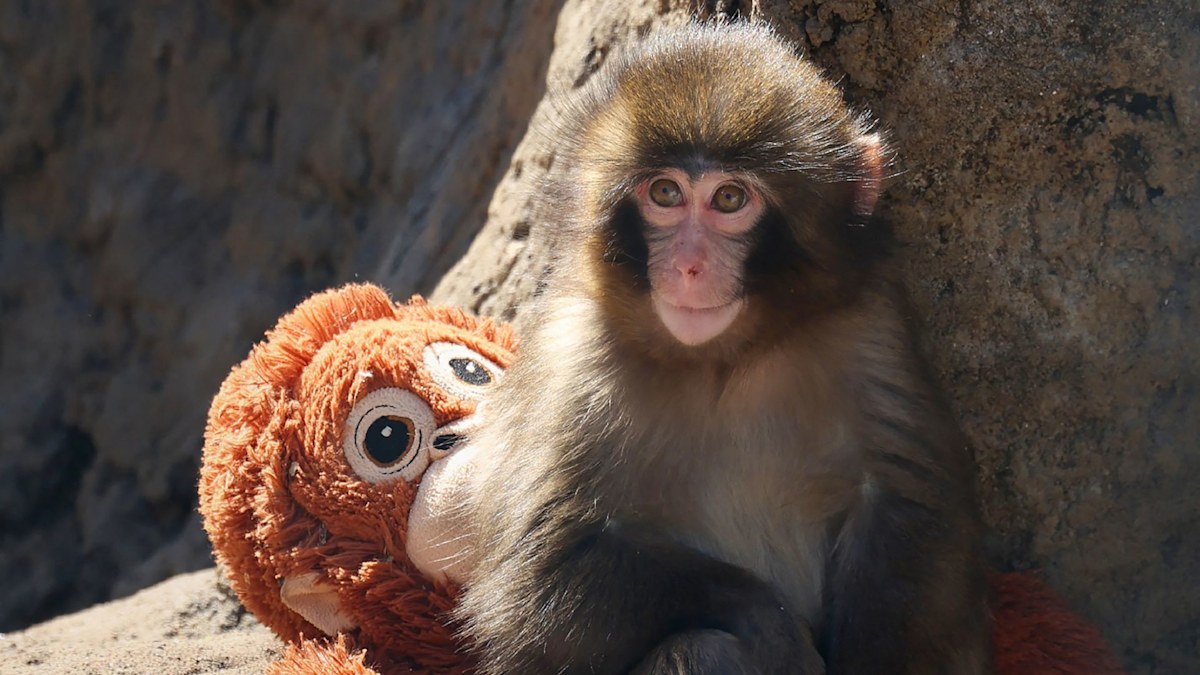

A very adorable baby Japanese macaque named Punch has been breaking the hearts of millions of social media users around the world as he struggles to integrate into the enclosure at Ichikawa zoo.
The now-viral monkey was rejected by his mother and was given a stuffed orangutan plush toy to keep him company while he adjusted to life in the Japanese city of Nomi.
After videos of other monkeys bullying the seventh-month-old primate brought the internet (and the HELLO! office) to tears, we couldn’t help but wonder what this fascination with a tiny animal more than eight thousand miles away was telling us about our own loneliness and attitude towards human connection.
As Punch and his teddy continue to pull at social media’s heartstrings, we asked leading psychologists what our inability to look away is revealing about our own loneliness epidemic in today’s society.
Attachment psychology in action, albeit through a screen
Aside from being ridiculously cute, there’s more to the Punch story than meets the eye. We’ve all fawned over videos of baby animals rolling around, but this time, there is a fierce need to offer protection to the monkey that’s sweeping the virtual airwaves. But why are we experiencing deep desires to alleviate his isolation, and why is Punch sparking such visceral emotions?
Behavioural psychologist, TV duty of care psychologist and relationship counsellor, Jo Hemmings, told HELLO!: “There is something profoundly primal about watching a baby animal being rejected. It bypasses intellect and goes straight to instinct.
“We are hard-wired to respond to vulnerability, particularly infant vulnerability, because, evolutionarily, survival depended upon it. When we see a baby monkey isolated and distressed, our mirror neurons fire up; we feel the rejection as if it were our own. It’s not sentimental weakness – it’s attachment psychology in action.”
She continued: “What intensifies that heartbreak is the screen itself. We’re witnessing something intimate from a distance, unable to intervene. That helplessness magnifies emotion. The internet allows us to observe suffering in real time, but it denies us physical connection. So, we compensate with outrage, commentary, and collective empathy.”
HCPC-registered Senior Education and Child Psychologist Dr Sasha Hall, who has over 15 years of experience, weighed in and said: “Humans are naturally drawn to protect babies.
“When we see a young creature experiencing rejection or distress, it immediately activates that instinct to care and comfort. A baby being separated from its mother is one of the most powerful emotional triggers we have because connection is so fundamental to survival.”
When we see a baby monkey isolated and distressed, our mirror neurons fire up; we feel the rejection as if it were our own. It’s not sentimental weakness – it’s attachment psychology in action.
She continued: “What makes Punch’s story particularly moving is how he seeks comfort in the toy when real connection is unavailable. That behaviour feels instantly recognisable. Children often turn to comfort objects when they feel unsettled or alone. Watching a tiny monkey cuddle a toy for reassurance reminds us just how simple the need for comfort really is, and that is why people feel it so deeply.
“Stories like this resonate because the emotions behind them are universal. Rejection, loneliness and the search for comfort are experiences everyone understands,” the expert explained.
“Even though the situation is far removed from our own lives, the emotional themes feel very familiar. That is why so many people find themselves unexpectedly moved by Punch’s story.”
What does this collective response say about society?
Such a large-scale reaction to a moment online is usually indicative of something more poignant than just a collection of likes or shares. This time, the experts think our outpouring of sympathy, love, and support for Punch is showing just how much we value other humans, whether we realise it or not.
Jo revealed: “We are highly sensitive to themes of abandonment and isolation because they resonate. Many people are carrying a low level of disconnection in their own lives. When a tiny monkey appears to be rejected by its mother, it becomes a symbol – a projection screen for our own fears of not being chosen, not being held, not being enough.”
The viral monkey moment is not trivial. It’s diagnostic.
“The scale of the reaction shows how much people still value connection. When millions of people respond emotionally to a story like this, it suggests that belonging, care and protection are things we instinctively recognise and respond to,” Dr Sasha added.
She went on to say: “At the same time, many everyday opportunities for connection have quietly reduced. Life has become faster, more digital and more convenient. We message instead of calling, order shopping to our doors and spend more time interacting through screens. Those changes are helpful in many ways, but they also mean fewer small moments of real social interaction.
“When a story like this appears online, people often gather around it emotionally. It becomes a shared moment where people recognise something deeply human.”
Constantly connected, yet drowning in loneliness
Despite being the most connected generation ever, with social media, video chatting and messaging at our fingertips, the United Kingdom is battling a loneliness epidemic that is highest among young adults.
In 2025, research by the Office for National Statistics found that around one in four adults in Great Britain reported feeling lonely “often, always, or some of the time”. Dr Sasha believes this has to do with what we now class as a type of connection.
She said: “Messaging and social media allow us to stay in touch constantly, yet they often lack the depth that comes with face to face interaction. You can see this shift culturally as well. Phone calls used to be normal. Now if someone rings unexpectedly, many people assume something must be wrong. That tells us a lot about how communication has changed.
 © Anadolu via Getty Images
“At the same time, modern life has been built around convenience. Online shopping, home delivery and digital entertainment mean we can go through large parts of our day without interacting with anyone at all. Those small everyday exchanges used to play a bigger role in helping people feel part of society.”
Jo highlighted: “The viral monkey moment is not trivial. It’s diagnostic. It reveals how hungry we are for connection, how reactive we are to rejection, and how quickly we gather around a shared emotional story. In that sense, the heartbreak isn’t really about the monkey at all. It’s about us.”
Is there a cure for loneliness?
As our world leans more into the idea of virtual reality and artificial intelligence, does that mean we are moving further away from real, in person connections and towards a life lived only online? The experts highlighted how fine that line really is and why we need to tred carefully.
Dr Sasha concluded: “Loneliness is unlikely to be solved by more digital connection. What helps most is meaningful, consistent interaction with other people in real life.
“Often that starts with small shifts. Calling someone instead of sending a message. Meeting a friend for a walk. Joining activities or community spaces where you see the same people regularly. Belonging tends to grow through repeated shared experiences.
“I do think there is hope. Human beings are naturally social, and there is growing awareness about how important community and connection really are.”
Echoing Dr Sasha’s sentiment, Jo shared her final thoughts: “As for whether loneliness can be resolved: it isn’t insurmountable, but it requires intention. We need to rebalance our relationships with fewer performative connections and more meaningful ones.
“That means fostering community offline, embracing awkward real-world interaction, and tolerating the discomfort of genuine intimacy.”
Dr Sasha Hall is an HCPC-registered Senior Education and Child Psychologist who has over 15 years of experience in the field and is a mother herself.
 © Emma Pharaoh
 © DAVID_MYERS_PHTOGRAPHY
Jo Hemmings is a behavioural psychologist, FMBPsS, specialising in media and news analysis in broadcasting, a TV and radio personality, a TV duty of care psychologist and a relationship and dating counsellor.
Read the full article here