



The tragic story of Amy Winehouse continues to evolve more than a decade after her death. Now, her ex-husband, Blake Fielder-Civil, is speaking out in a rare interview, challenging long-standing narratives about responsibility, addiction, and their deeply complicated relationship.
For years, Fielder-Civil has been widely portrayed as the central figure behind Winehouse’s descent into drug addiction. But in a candid appearance on the “We Need to Talk” podcast on March 17, he offered a more nuanced perspective, acknowledging his role while firmly rejecting the idea that he alone was to blame.
The Blame Narrative Gets Reexamined
Fielder-Civil addressed the long-standing public perception head-on, making it clear he is not avoiding accountability, but also not accepting full responsibility. “My stance now is that I know a lot of people, especially people reading media 20 years ago, would have an idea that Amy’s passing is my responsibility,” he said. “As I’ve always said, I never shirk from any responsibility. If I’ve done something, I’ll put my hand up to it.”
He admitted he has “made peace” with having “a part to play,” but emphasized that Winehouse had autonomy over her choices. “Amy herself had agency. And that is in no way at all disrespecting her by saying that, but Amy did what she wanted to do,” he explained. “And even though the drinking had started to hurt her, she carried on… She’s actually a very strong woman.”
Inside Their Relationship and Early Years
The pair first met in a London pub around 2001, long before global fame transformed Winehouse’s life. Fielder-Civil recalled being immediately drawn to her. “I thought she was a beautiful woman,” he said.
 © FilmMagic
At the time, neither were deeply involved in drugs. Their early relationship, however, became increasingly turbulent, eventually inspiring Winehouse’s critically acclaimed 2006 album “Back to Black.” The couple married in Miami in 2007, cementing a bond that would become both iconic and controversial.
“These are memories which are hard for me to revisit,” he shared. “That was my best mate, and we were happy. And the drugs was a side of it, eventually.”
 © WireImage
He was firm in separating their love from their struggles. “Our love had nothing to do with addiction. And addiction had nothing to do with our love. That’s where it went. It wasn’t who we were.”
Drug Use, Responsibility, and Public Misconceptions
One of the most scrutinized aspects of their relationship has been drug use. Fielder-Civil acknowledged introducing Winehouse to heroin but pushed back on the idea that he forced or controlled her actions. “I never blamed a person that gave me drugs for the first time. I’ve never tried to put that on anyone. Why would I?” he said. “Do these people think that I forced Amy to do drugs? That’s just not what happened… I wasn’t the dealer.”
 © Getty Images
He also pointed out that Winehouse’s addiction intensified during periods when he was incarcerated, challenging the simplified narrative that he was always the driving force behind her struggles.
The Day Everything Changed
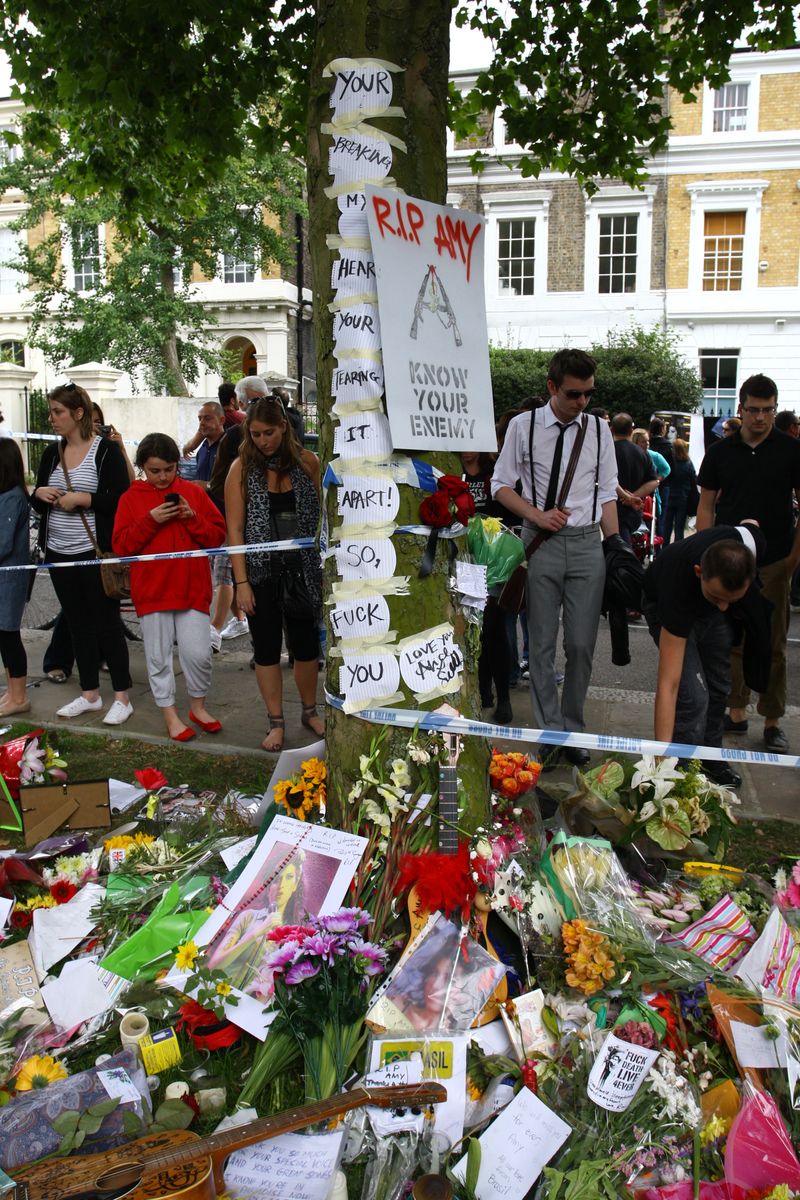
Winehouse died in 2011 from accidental alcohol poisoning at age 27, notably without drugs in her system at the time. Fielder-Civil was in prison when he received the devastating news.
“I used to pray every night… ‘Please let Amy stay alive until I get out,’” he recalled. “My first thought was, ‘This is my worst nightmare. It’s not true.’… I burst into tears.”
 © Getty Images
Unable to attend her funeral, he described grieving in isolation while simultaneously being vilified in the media. “It took me a long time to grapple with the fact that I had not only lost my best mate, but was also being blamed for her death,” he said.
Moving Forward With Sobriety and Perspective
Today, Fielder-Civil says he is clean, sober, and in a stable relationship. Reflecting on how Winehouse might view his life now, he believes she would be proud. “I know Amy wouldn’t want me to still be sat here 20 years later saying it was all my fault,” he said. “She’d be saying, ‘Get it right, babe. Come on. Tell them the truth.’”
 © Getty Images
He added a final, sobering reflection on their shared past: “We were just young addicts at the time. We weren’t to start with, then we were, and it could happen to anyone.”
If you or someone you know is struggling with substance abuse, support is available through the SAMHSA helpline at 1-800-662-HELP.
Read the full article here