
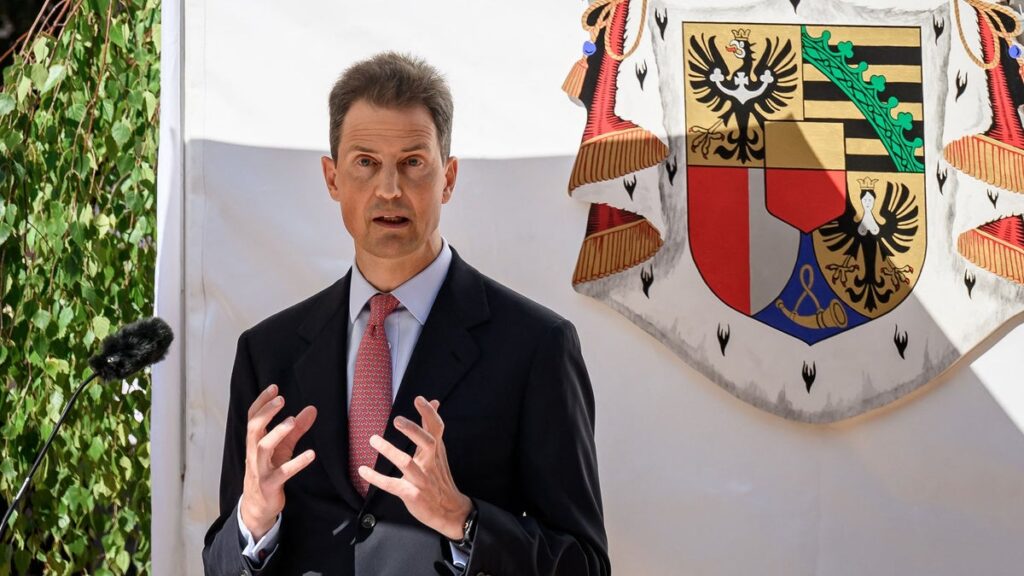
Liechtenstein is rewriting centuries of royal tradition. Hereditary Prince Alois announced on Saturday, August 15, that women will be able to inherit the throne under a historic change to the principality’s succession rules. The announcement came during National Day celebrations at Vaduz Castle and marks a new chapter for one of Europe’s oldest royal houses.
Liechtenstein Changes Its Rules of Succession
“I am pleased to inform you of a decision of great importance to our House, an issue that has been discussed within the family in various forms for decades. It concerns an amendment to the rules of the Princely House, a formal process that began late last year and that, on Wednesday, secured the required two-thirds majority among family members entitled to vote,” Prince Alois said in his speech.
As the hereditary prince explained, the change was neither a government decision nor a reform put to a popular vote. In Liechtenstein, succession is governed by the laws of the Princely House, a centuries-old body of family rules that has constitutional recognition. As a result, the sovereign family has the authority to determine who may ascend the throne and under what conditions.
Prince Alois went on to explain the significance of the decision. “Under this amendment, all female descendants of the Princely House will have the same rights of participation as male descendants in matters governed by the House Law. In addition, succession to the throne will shift from male-preference primogeniture to absolute primogeniture. This means that, in the future, the firstborn child, regardless of sex, will become heir to the throne and, subsequently, Princess or Prince of Liechtenstein.”
He added, “With these changes, we want to ensure that, in the future, responsibility for the House and the country rests with the person who has received the best preparation for these duties. As a rule, this will be one of the children of the reigning prince or princess, who grow up here and become familiar from an early age with the particular characteristics of the country and the Princely House.”
The New Rules Will Apply to Future Generations
According to the local newspaper Vaterland, the new succession rules will not affect members of the House of Liechtenstein who have already been born. In an interview, Hereditary Prince Alois clarified that the change will apply only to future births.
Until now, Liechtenstein had been the only one of Europe’s 10 reigning monarchies in which women were barred from ascending the throne.
Who Is Hereditary Prince Alois?
Alois is the eldest son of Prince Hans-Adam II and Princess Marie and is therefore heir to the throne. Since August 15, 2004, he has carried out the duties of head of state on behalf of his father.
Hereditary Prince Alois married Duchess Sophie in Bavaria on July 3, 1993. The couple have four children: Prince Joseph Wenzel, born May 24, 1995; Princess Marie Caroline, born October 17, 1996; Prince Georg, born April 20, 1999; and Prince Nikolaus, the youngest, born December 6, 2000.
As the couple’s firstborn child, Joseph Wenzel remains next in line to the throne.
Liechtenstein celebrates National Day every year on August 15, with a full program of official ceremonies and public festivities. Among the highlights are the official state ceremony, where Prince Alois made what is one of the Principality’s most consequential announcements in recent years; a large folk festival in the center of Vaduz, and the traditional illumination of the mountains after nightfall.
Read the full article here


