

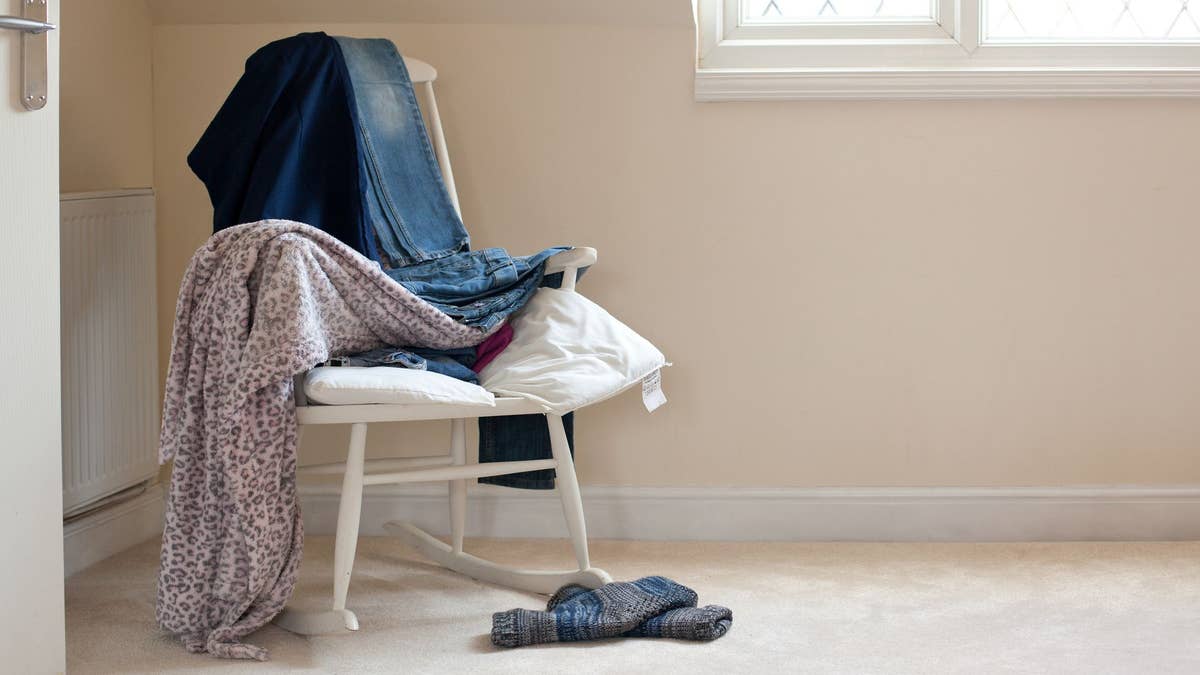

It’s a scene played out in millions of homes every single day. You walk into the bedroom, glance over at the chair that’s supposed to be for seating – and discover it has completely vanished beneath a mountain of random clothes that are “good for another wear”.
While many view this habit as a clear sign of untidiness or laziness or a total lack of organisation, psychology suggests otherwise. In fact, in the vast majority of cases, it likely has absolutely nothing to do with the reasons you might think.
This phenomenon is confirmed by psychologist Sara Navarrete, who explains that infamous chair buried under clothes can actually be a sign of a saturated mind.
After a long day packed with decisions, responsibilities, endless messages, to-do lists and worries, our brains simply start to ration energy on anything considered secondary.
At that point, putting away a t-shirt or hanging up a dress in the wardrobe drops right to the bottom of the priority list.
The psychology behind the ‘halfway house’ between order and chaos
We all know “the chair”. It’s there in our own bedroom, the kids’ rooms, or we’ve spotted it at a friend’s, a partner’s or our parents’ house.
It’s the ultimate dumping ground for a certain type of laundry: clothes that aren’t quite dirty enough for the washing machine, but aren’t clean enough to go back in the wardrobe either.
As Navarrete explains, this particular piece of furniture effectively becomes a sort of halfway house between order and chaos. “Most of the time, it’s not down to laziness or neglect,” she says. “It’s simply a postponed decision.”
You look at an item of clothing and think, “It’s not dirty enough to wash yet, but it’s not clean enough to go back in the wardrobe.” And it’s that exact moment of indecision that ends up creating the infamous pile.
“A lot of people give themselves a really hard time about the state of their house, when in reality, that mess is just the visible symptom of an invisible mental exhaustion”
When you’ve been making decisions, solving problems, and juggling responsibilities all day, even something as simple as deciding what to do with a t-shirt becomes a task you’d rather just leave for later.
What the infamous pile secretly reveals about how you tick
The psychologist explains that this habit often reflects how we organise our lives in general – specifically, our tendency to prioritise the urgent over the important. In other words, people who let clothes pile up on the chair are usually great at tackling things with immediate consequences, but will happily leave small daily tasks for later.
This type of person tends to function perfectly when it comes to the essentials of life. They hold down jobs, meet deadlines, look after their families and keep their commitments. But when energy levels start to dip, certain tasks automatically drop straight to the bottom of the pile.
In fact, Navarrete points out that having a chair for random clothes can actually reflect a highly practical personality. These are people who don’t need everything to be absolutely spotless to feel content, and who prefer to save their mental bandwidth for things they consider more important.
The clothes chair habit says far more about how we manage our attention than how we manage our wardrobe
The ‘silent’ link between bedroom mess and daily burnout
That said, it can also be a telltale sign of stress. If you think about it, we all have times when the clothes start piling up, paperwork begins to take over, or small jobs are left half-done. More often than not, this coincides with periods of heavy stress, overwork, or emotional burnout.
When we’re stressed, the brain essentially goes into survival mode. It focuses entirely on whatever it considers a priority and cuts back on the energy available for everything else. What’s more, the psychologist highlights a particularly interesting point: often, the mess isn’t actually the cause of the stress, but rather a visible symptom of it.
 © Getty Images
Why your home environment tells your true emotional story
This connects perfectly with a phrase Navarrete frequently uses with her clients: “Our home usually reflects what we’re going through emotionally.”
While she steers clear of sweeping statements like, “If your house is a mess, it means you’re struggling,” she does recognise the incredibly close link between our mental state and the spaces we live in.
After all, home is the one place where we can stop putting on a brave face. It’s where we unwind, and where our emotional energy shows through in its most authentic form.
Because of this, when someone is going through a period of intense stress, grief, a breakup, motherhood or trouble at work, it’s completely normal for their surroundings to change too. It’s not that they suddenly want to live in a tip; it’s just that the vast majority of their mental energy is being spent on simply keeping their head above water.
The turning point: When does a messy chair become a mental health issue?
Having clothes on the chair from time to time isn’t necessarily a “sign”. We all leave small jobs for later when we’re tired or have other priorities. The real turning point is when that habit starts to cause actual discomfort.
 © Getty Images
According to Navarrete, if you feel a pang of guilt, frustration or a sense of losing control every time you walk into the room – or if it’s causing rows with the people you live with – then the problem is no longer the clothes.
“We’re talking about the emotional impact the habit is having,” she says. “The difference isn’t the size of the pile; it’s how it makes us feel.”
We also have to bear in mind that often we aren’t actually postponing hanging up a t-shirt. What we’re putting off is making a decision about it: Do I put it away? Do I wash it? Will I wear it again tomorrow? “It might sound daft, but our brains register every single one of those tiny, unresolved decisions,” explains the psychologist.
The expert reminds us of a psychological phenomenon known as the Zeigarnik effect. This tendency dictates that incomplete tasks stay active in the back of our minds, quietly draining our mental resources even when we aren’t consciously thinking about them.
That’s why the issue usually isn’t the pile itself; what actually weighs us down is the message we get every time we look at it: “I’ve still got things to do.”
When you multiply that feeling by unanswered emails, missed calls, put-off tasks or decisions we keep delaying, we end up living surrounded by constant little reminders of everything we haven’t wrapped up yet. And eventually, that’s what completely overloads the brain.
 © Getty Images
Finding the happy medium: How to ditch the pressure of a perfect home
The psychologist stresses that the goal shouldn’t be a flawless house, but a functional one. Good mental health doesn’t mean keeping everything immaculate 24 hours a day, but you don’t want to live in total chaos either. The key is to find a happy medium that allows you to feel comfortable, without letting tidiness become just another source of pressure.
That’s why the specialist recommends decluttering, setting up simple organisation systems, spending just a few minutes a day on small jobs, and above all accepting that a lived-in house will never be perfectly tidy all the time.
And perhaps that is the most important takeaway of all: sometimes the problem isn’t actually the chair buried under clothes, it’s the exhaustion, the pressure, or the mental load that we’ve been carrying around for too long.
Because, as Navarrete reminds us, a perfectly tidy house doesn’t guarantee peace of mind. A calm mind, however, tends to approach getting organised in a much healthier way.
About the expert
Sara Navarrete is a clinical psychologist specialising in self-esteem, relationships and emotional well-being. You can follow her on Instagram.
Read the full article here